

An environmental claim is only as good as what stands behind it. Here is what ONE-DNA™ can influence by design, what we measure, and what still depends on everyone who handles a surface after us.
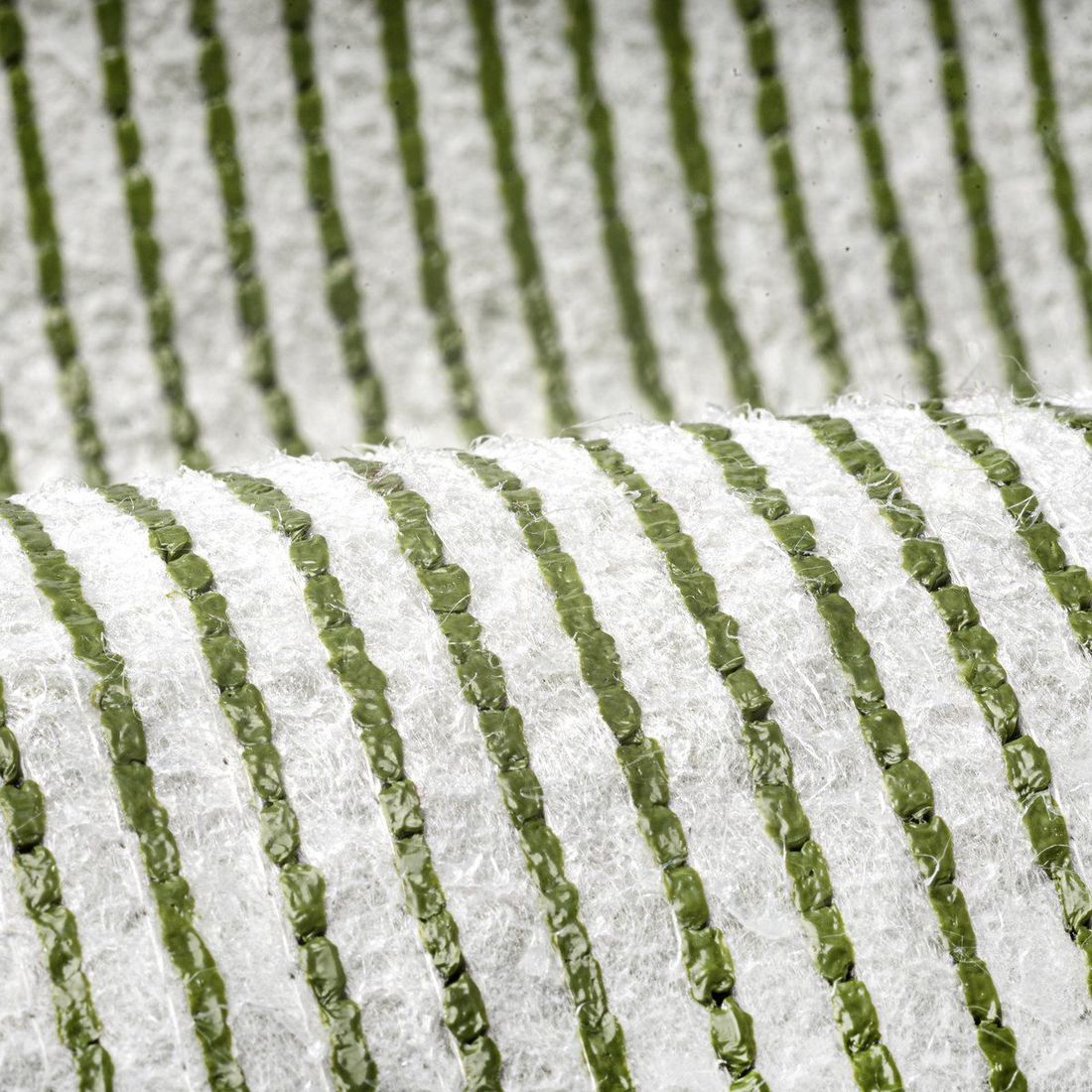
A surface’s life
Design decides the start. Many hands decide the end.
By the time a surface is lifted, most of what decides its future was chosen years earlier. Some of it is ours to design. The rest is not.
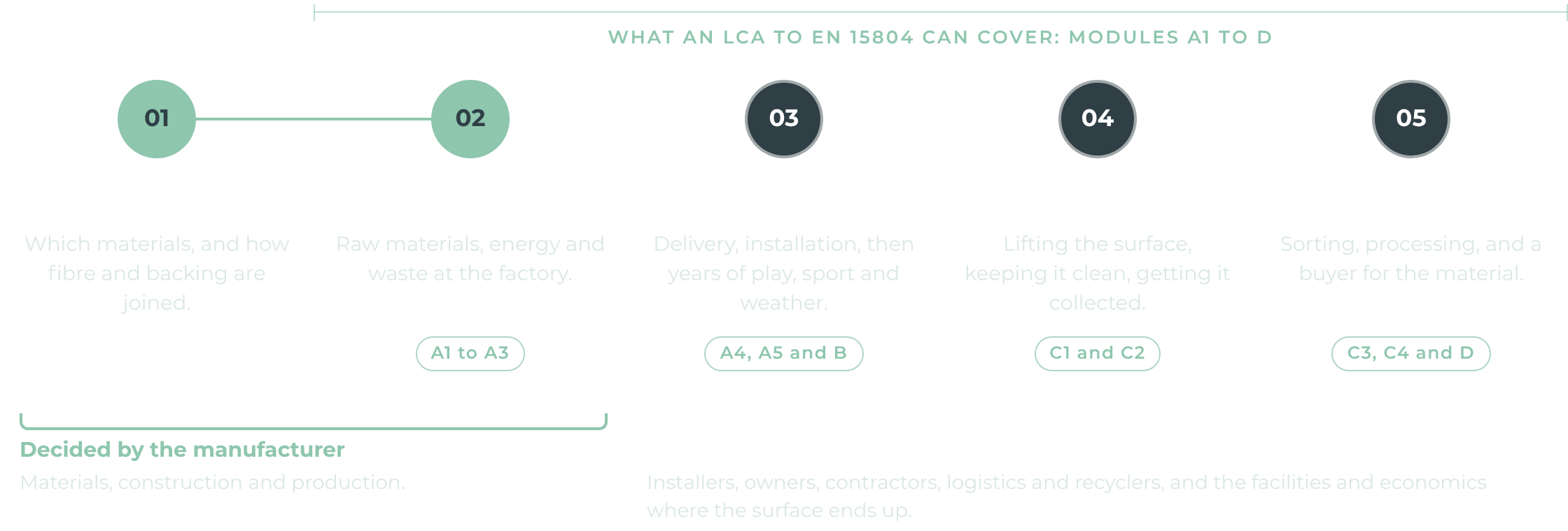
ONE-DNA™ works on steps 01 and 02: one material route per product and no conventional latex or polyurethane coating, so there is less to separate later. That creates the conditions for recovery. It does not guarantee it.
From recyclable to recycled
Three questions before anything is recycled.
‘Recyclable’ only answers the first. A surface is recycled when all three are true where it ends up.
Can it be recycled?
Technically possible.
- Carpet, infill and polymers separated
- Contamination removed
- Material processed into recyclate
Can it get there?
Practically available.
- Collected after removal
- Transported to a facility
- A facility permitted, and nearby
Does it work economically?
Viable at scale.
- Collection and processing have a cost
- Recyclate needs a buyer
- Capacity must match volumes
Specialist recyclers already process conventional artificial grass. A simpler construction helps with the first question; it cannot answer the other two on its own.
From design to practice
Designed for recycling. Exploring the routes to make it happen.
Designing artificial grass for recycling is an important first step. Making material recovery work in practice takes more.
That is why ONE-DNA™ is exploring with existing recyclers what their processes can accept. In this film, we visit Synaplast, a plastics recycler in Germany, to see why so much plastic is still lost at end of life, and why material composition decides what can come back.
Different markets need different routes. Step by step, we look at what recyclers accept, how material needs to be prepared, and what it takes to scale up.
Explore the recycling journey →Spoken in German, with English subtitles.
Measured, not assumed
A green surface doesn’t tell you its footprint.
Easier to recover is not the same as lower impact. That is why life cycle assessment is part of how ONE-DNA™ products are developed: to see where impact sits and reduce it, while keeping the performance each application needs.
What an LCA does
In one line
A Life Cycle Assessment measures environmental impact across defined stages of a product’s life, the modules shown above.
What to look for
Which product, which production site, which modules, and per what unit.
What an EPD does
In one line
An Environmental Product Declaration publishes LCA results in a standard format, checked by an independent verifier.
What to look for
The declared modules, the functional unit and the verification statement.
Comparing suppliers? Ask which product, which construction, which production site, which modules, and verified by whom. An LCA or EPD does not prove that a product will be recycled. How the construction works →
Our data today
Environmental data, with its scope stated.
Before you compare any environmental data, check what it covers. This is where ours stands, and where it stops.
Life Cycle Assessment
Production in Portugal
Carried out by EcoReview to EN 15804+A2 for production in Cortegaça, Portugal. Modules A1 to D, per m² of installed top layer. Results apply only to the product families and site assessed.
Independent verification in progress
Environmental Product Declarations
Based on that assessment
Product-specific EPDs are in their final stage. They are shared once independently verified and published. Until then, results are not presented as declared.
Not yet published
Earlier EPDs
A previous production site
MRPI-registered EPDs cover five 100% PE products made at an earlier production location, modules A1 to A3. They describe that production, not today’s production in Portugal.
Historical, scope limited
Interview in English, with English subtitles.
Independent product assessment
When material choices are backed by evidence.
In Sweden, Nordic Grass Fun 24 ONE-DNA™ has received the assessment Rekommenderas (Recommended) from Byggvarubedömningen (BVB), covering both material content and life-cycle criteria.
For architects and specifiers, structured product assessments provide useful information when comparing materials and documenting project decisions.
Hear Erik Hedberg of Nordic Surface explain the journey behind this assessment.
Nordic Grass Fun 24 ONE-DNA™ | BVB, 20 March 2025
- OverallRekommenderasRecommended
- ContentRekommenderasRecommended
- Life cycleRekommenderasRecommended
The assessment applies to this specific product, supplied in Sweden by Nordic Surface Sweden AB (BVB ID 165701). BVB is a Swedish building-product assessment, not a UK standard or approval.
How Byggvarubedömningen assesses products ↗FAQ
Questions about environmental claims
It is designed for recycling: one material route per product and no conventional latex or polyurethane coating, so there is less to separate. Whether a surface is actually recycled depends on removal, collection, sorting and the processing available where it ends up. Designed for recycling is not a guarantee.
Earlier MRPI-registered EPDs cover five 100% PE products from a previous production location, modules A1 to A3. EPDs for production in Portugal are in their final stage and are shared once independently verified and published.
An LCA measures a product’s environmental impact across defined life cycle stages. An EPD publishes those results in a standard format, after independent verification. Neither proves that a product will be recycled.
Not automatically. A simpler construction can make recovery easier, but impact has to be measured per product, within a stated scope, and compared on the same basis.
No. Modules A1 to D describe which life cycle stages an assessment covers. Cradle to Cradle Certified® is a separate certification programme. ONE-DNA™ does not claim that certification.
Tell us the product and project you have in mind. We share the documents that apply to that product, with their scope. Request environmental documents →
Looking for a product or a supplier? Explore products → Find a supplier →