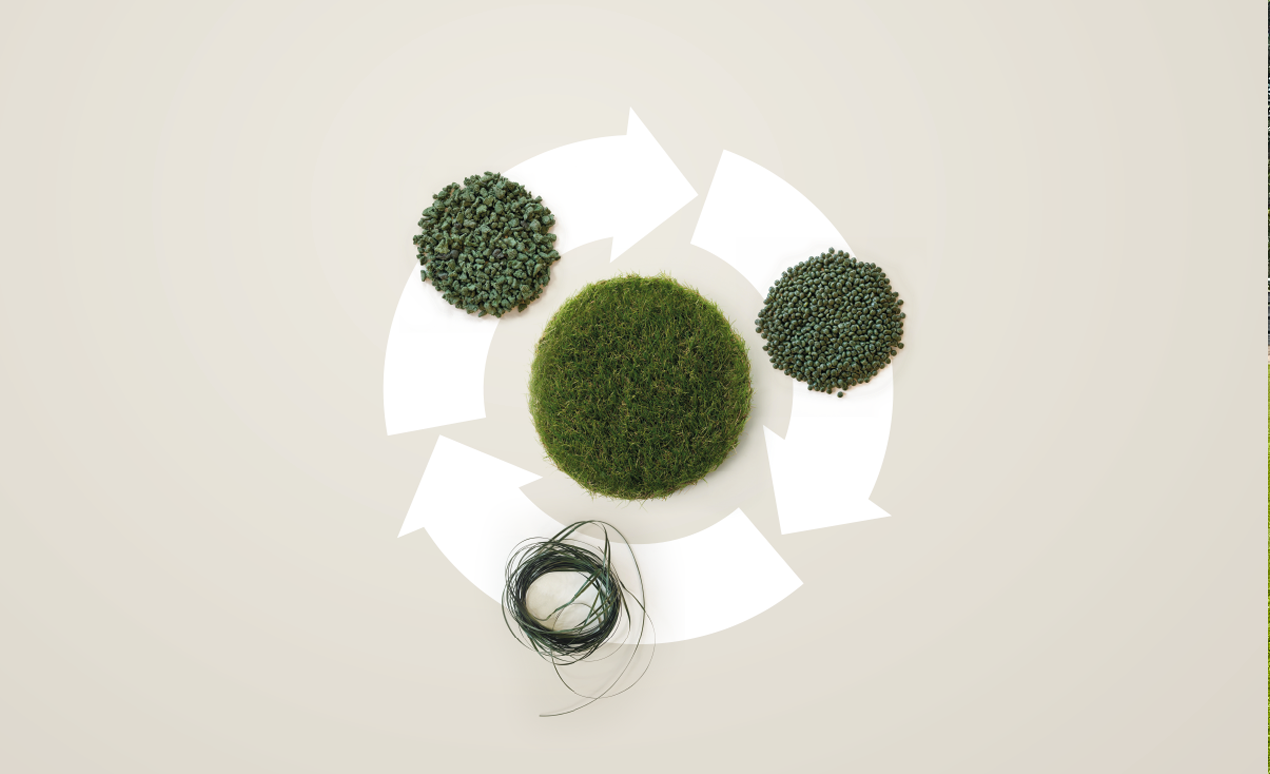
As resource efficiency and responsible material management become increasingly important, product design plays a growing role in determining how materials can be processed at the end of a product’s service life. Within the artificial grass industry, manufacturers are exploring ways to simplify recycling processes and improve material recovery opportunities.
Designing for end-of-life processing
The composition of an artificial grass system has a significant influence on how it can be processed after use. Products manufactured from multiple polymers often require additional separation and processing steps before recycling can take place.
The ability to recover and reuse materials depends on several factors, including product composition, collection systems, available recycling infrastructure and the intended application of the recovered material.
Understanding downcycling
Many artificial grass products contain a combination of materials, such as polyethylene (PE), polypropylene (PP), latex or polyurethane-based components. When these materials are processed together after use, the resulting recycled material may no longer retain the same characteristics as the original raw materials.
This process is commonly referred to as downcycling. While the recovered material may still be suitable for certain applications, its potential uses can become more limited compared to the original material.
What mono-material design can change
One approach to reducing material complexity is mono-material product design. ONE-DNA™ artificial grass is manufactured using polyethylene (PE) as its primary polymer, creating a more homogeneous material composition.
Using a single polymer type can simplify material processing and may facilitate recycling where suitable collection and recycling systems are available. By reducing the number of different polymers within the product, material recovery processes may become less complex compared with systems that contain multiple polymer types.
Material consistency and recovery potential
Maintaining material consistency can be an important consideration when designing products intended for end-of-life processing. A mono-material approach may help preserve the characteristics of the recovered material, depending on the collection, sorting and recycling processes used.
The ONE-DNA™ concept focuses on material consistency through a polyethylene-based design.
Looking ahead
As recycling technologies and material recovery systems continue to evolve, product design is expected to play an increasingly important role in supporting efficient end-of-life processing.
Mono-material artificial grass represents one approach to reducing material complexity and supporting material recovery pathways. By considering product composition from the outset, manufacturers can help prepare products for future recycling opportunities while providing greater transparency regarding material content and end-of-life management options.
Updated October 2026: references to a take-back programme have been revised. ONE-DNA™ does not currently operate a take-back programme in any market.
Update, October 2026: this article reflects the ONE-DNA™ range at the time of publication, based on polyethylene (PE). ONE-DNA™ now also includes a 100% PO route; see Technology for the current material routes.
Related: Sustainability · Technology