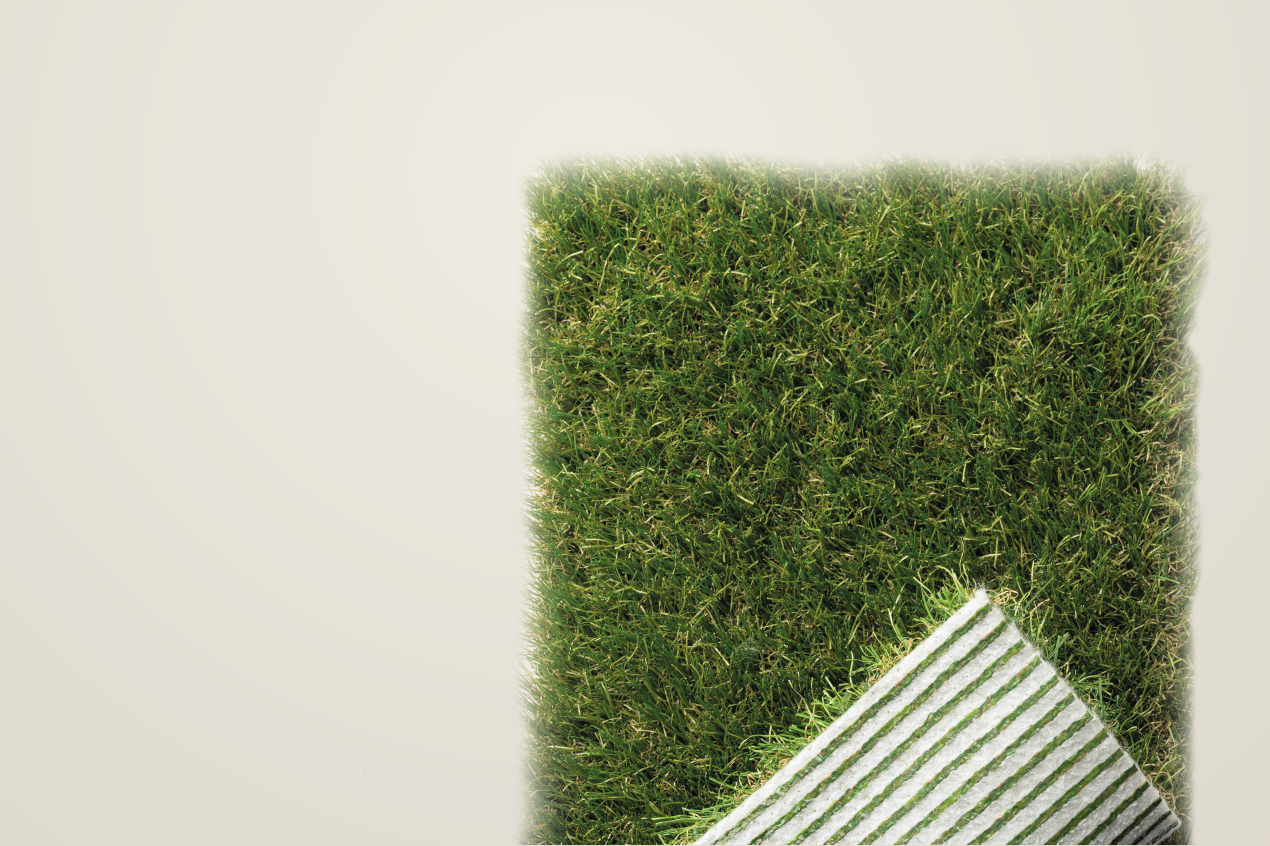
Artificial grass products can be manufactured using different material structures. One of the most important distinctions is whether a product is based on a mono-material or multi-material design.
Understanding these differences can help municipalities, architects, installers and project developers make more informed decisions when evaluating product composition and future processing options.
Mono-material artificial grass
A mono-material product is manufactured primarily from a single polymer. ONE-DNA™ artificial grass is based primarily on polyethylene (PE), creating a mono-material product structure.
Using a single polymer throughout the product can simplify material identification and processing compared with products that combine multiple polymer types.
Multi-material artificial grass
Many conventional artificial grass systems are manufactured using combinations of materials such as:
- Polyethylene (PE)
- Polypropylene (PP)
- Latex or Polyurethane (PU)
These materials may be used within fibres, backing layers, reinforcement structures or coatings.
Because different materials are combined within a single product, additional processing steps may be required when materials are handled after use.
Material properties and processing
Different polymers possess different physical characteristics.
One example is melting temperature.
Polyethylene (PE)
Polyethylene has a relatively consistent processing range, which allows the material to behave predictably during manufacturing and material processing operations.
Mixed Polymer Systems
When different polymers are present within a product structure, each material may require different processing conditions. As a result, additional sorting, separation or processing steps may be necessary depending on the intended recovery route.
Product transparency
Understanding material composition is becoming increasingly important for project owners, municipalities and specifiers.
For this reason, ONE-DNA™ is supported by independent product assessment and documentation, through testing and Environmental Product Declarations (EPDs).
An EPD provides standardised information on the environmental profile of a product for the life cycle stages it declares, and allows products performing the same function to be assessed using a common methodology.
Independent testing
ONE-DNA™ products have been subjected to a range of independent assessments, including:
- Environmental Product Declaration (EPD) development
- Material composition evaluations
- Leaching assessments
- EN 71-3 testing
- Product ageing assessments
These evaluations provide documented information regarding product characteristics and performance.
Looking ahead
As material efficiency and product transparency continue to gain importance across multiple industries, mono-material design approaches are receiving increased attention.
ONE-DNA™ represents an approach to mono-material artificial grass design, focusing on material consistency, documented product information and Design for Recycling principles.
Update, October 2026: this article reflects the ONE-DNA™ range at the time of publication, based on polyethylene (PE). ONE-DNA™ now also includes a 100% PO route; see Technology. The EPDs mentioned (MRPI, 2024) cover the product stage (A1 to A3) of products made at the former Hasselt site and do not represent current production in Portugal.
Related: Technology · Sustainability