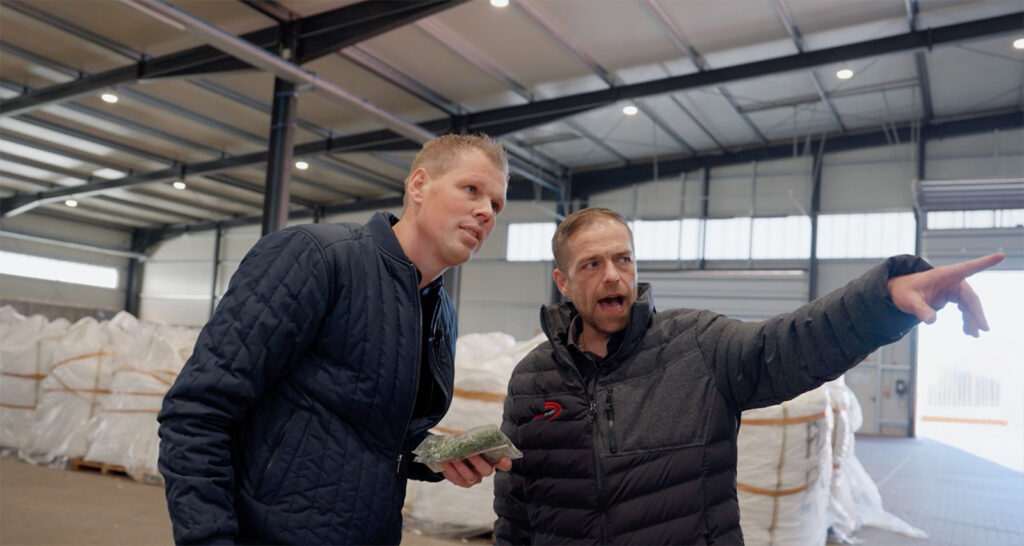
Lars Solberg, our Changemaker in Norway, combines practical experience in both artificial grass installation and material processing. Through TeBe Sports, he works with sports field construction and maintenance, while through All Sports Recycled he is actively involved in the handling and processing of artificial turf materials after use.
Drawing on this experience, Lars shares his perspective on how material composition influences recycling and processing possibilities.
Artificial grass and material complexity
Artificial grass is widely used in sports, landscaping and recreational environments due to its durability and consistent performance.
However, from a recycling perspective, many existing artificial grass systems present a challenge because they contain multiple materials within a single product structure.
Typical systems may contain combinations of:
- Polyethylene (PE)
- Polypropylene (PP)
- Polyurethane (PU)
- Latex
- Nylon
- Sand or performance infills
Each material serves a purpose within the system, but the combination increases overall material complexity.
The challenge of material separation
According to Lars, one of the main challenges recyclers face is separating different material streams efficiently.
When artificial grass reaches our facility, a large part of the work involves identifying, separating and processing the different materials contained within the system.
The complexity of this process depends largely on the number of materials present and how they are combined within the product.
Why material composition matters
From a processing perspective, recyclers often aim to create consistent material streams.
The more homogeneous the material composition, the easier it becomes to identify, process and manage the resulting material stream. This is one of the reasons why material transparency and Design for Recycling principles are receiving increasing attention across multiple industries.
Looking at mono-material concepts
Lars believes that product designers are increasingly considering how material choices influence future processing possibilities.
Products based on a single material family can simplify material identification and reduce overall complexity compared to products that contain multiple polymers.
The fewer material types involved, the more straightforward the processing pathway can become.
The relevance for artificial grass
The ONE-DNA™ concept is based on a mono-material polyethylene design. From a recycler’s perspective, this provides a consistent material structure that differs from many traditional artificial grass systems.
While processing methods will always depend on local infrastructure, available technologies and market conditions, simplified material composition can provide additional options when evaluating future material pathways.
Looking ahead
For Lars, the discussion about artificial grass recycling begins long before a product reaches the end of its service life.
The most important decisions are often made during product development. Material selection influences what options may be available later.
As material transparency, traceability and Design for Recycling become increasingly important, recyclers, manufacturers and project owners are likely to work more closely together to better understand how product design affects future processing possibilities.
Update, October 2026: this article reflects the ONE-DNA™ range at the time of publication, based on polyethylene (PE). ONE-DNA™ now also includes a 100% PO route; see Technology for the current material routes.
Related: Sustainability · Sport