Artificial grass has become an established solution in both sports and landscaping applications. As discussions around resource efficiency, material recovery, and product lifecycles continue to evolve, increasing attention is being given to the way artificial grass systems are designed and manufactured.
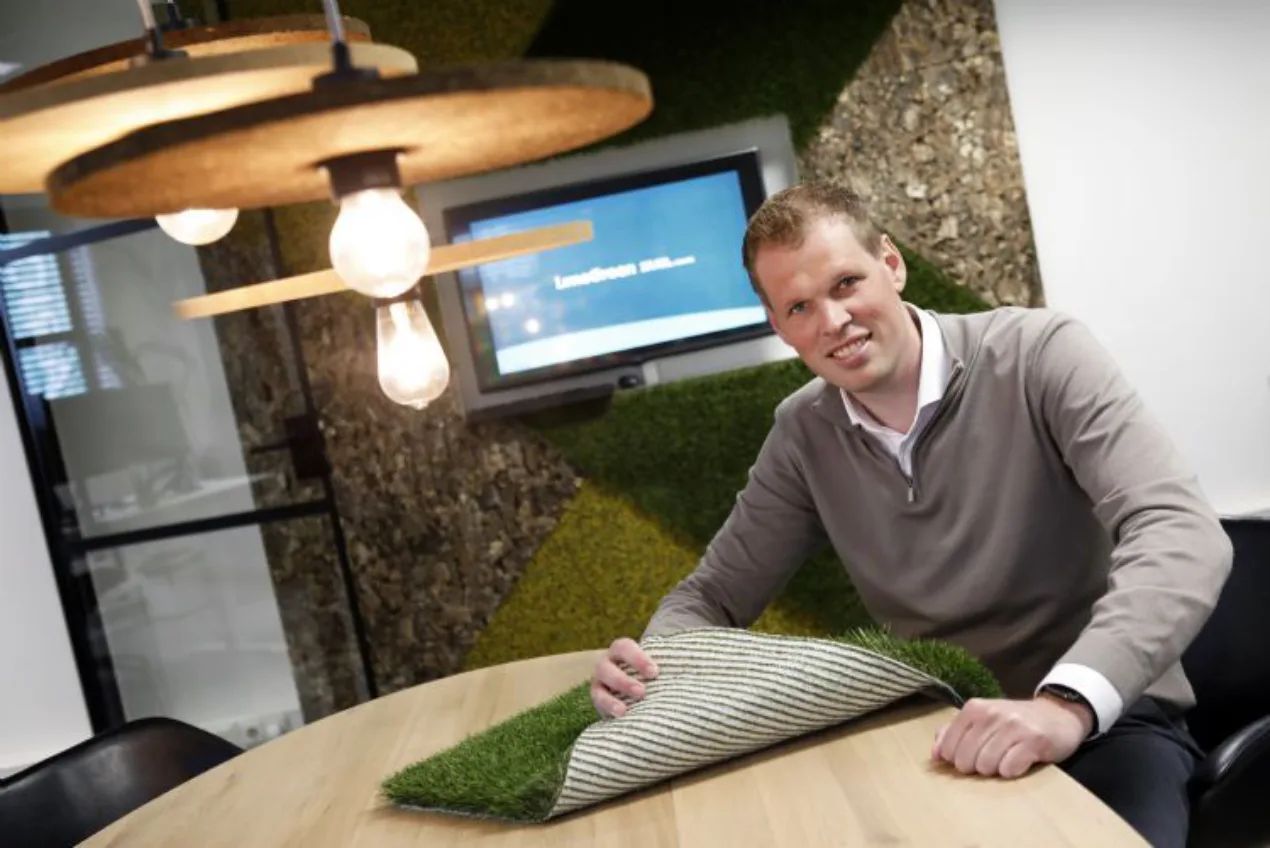
One initiative exploring this topic is ONE-DNA™, started by Jasper Eppingbroek. In collaboration with industry partners, his team has developed an artificial grass product based on a single-polymer construction known as ONE-DNA™.
Reducing material complexity
Traditionally, artificial grass products are often manufactured using multiple materials that each fulfil a specific function within the system.
According to Eppingbroek, one of the objectives behind ONE-DNA™ was to investigate whether material complexity could be reduced while maintaining product performance.
“Polyethylene has been used in artificial grass for many years. With ONE-DNA™, we explored whether it would be possible to construct the entire product from a single polymer, including both the fibre and the backing. This approach simplifies the material composition and may create new opportunities for material recovery at the end of the product’s service life.”
Product design and recyclability
The ability to recover and reuse materials is influenced by many factors, including product design, collection systems, sorting processes, and available recycling technologies.
The ONE-DNA™ team believes that simplifying the material composition of artificial grass products can contribute to these discussions by reducing the number of materials that need to be separated during processing.
Independent evaluation
To better understand the recyclability characteristics of the product, the team commissioned research from SGS Intron.
According to the team, the assessment examined the behaviour of both the fibre and backing materials when reprocessed into new polyethylene applications. The findings provided additional insight into the potential for material recovery and reuse within suitable recycling streams.
Developing practical collection systems
Alongside product development, the team was working with recycling partners to explore collection and processing models for artificial grass offcuts and end-of-life materials.
In 2022 the team initiated a pilot programme involving local collection of installation waste and removed artificial grass products. The objective is to better understand collection logistics, participation levels, and the practical requirements needed to support future recycling activities.
Looking ahead
For the ONE-DNA™ team, circularity extends beyond product design alone.
Product design is only one part of the equation,” says Eppingbroek. “Collection, processing, logistics, and collaboration throughout the value chain are equally important. By working together with partners, we hope to continue learning about how material recovery can be further integrated into artificial grass systems in practice.
As discussions around circularity continue to develop, initiatives such as ONE-DNA™ contribute additional perspectives on how artificial grass products can be designed with end-of-life considerations in mind.
Update, October 2026: this article describes the original ONE-DNA™ concept from 2022, based on polyethylene (PE). ONE-DNA™ now also includes a 100% PO route. See Technology for the current material routes.
Related: Sustainability · R&D