Why the synthetic turf of yesterday depends on a handful of specialists, and the synthetic turf of tomorrow may be able to use an infrastructure that already exists.
A ONE-DNA™ perspective.
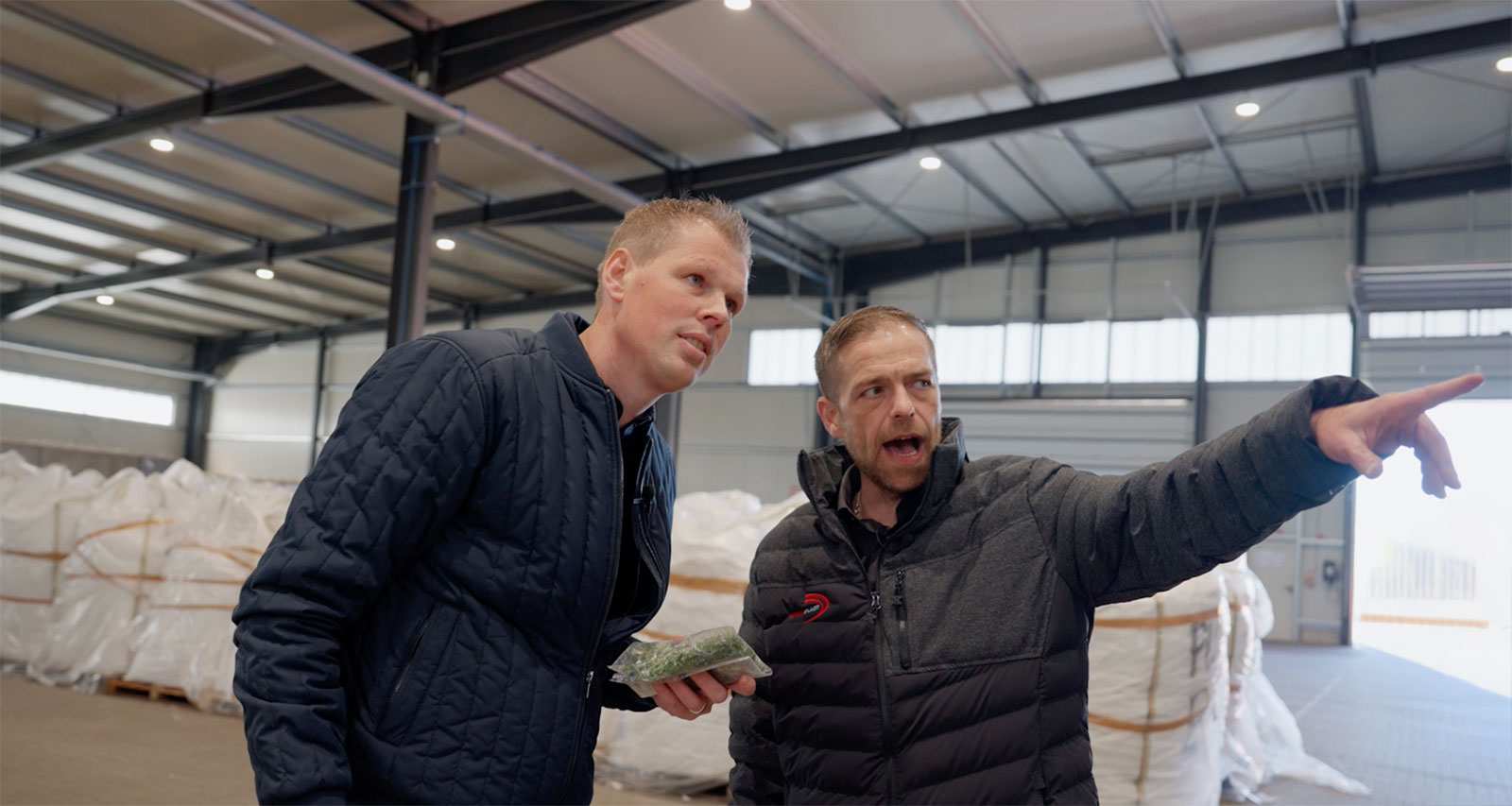
During a visit to Synaplast GmbH, a plastics recycler in Niederlangen, Germany. Managing Director Daniel Schwerhoff and his team walked us through the practical realities of recycling plastic, from how waste arrives to what it takes to turn it back into usable material. Over the coming days we are sharing what we saw, and what it means for the way synthetic turf is designed.
Recyclable is not the same as being recycled.
Much of the synthetic turf installed across Europe over the past twenty years is currently processed through a relatively small number of specialist recycling routes. And even where those routes exist, they are most commonly used for sports fields. Landscaping, playgrounds, padel courts and event surfaces appear to find it far less frequently, though the picture varies by country and segment.
This is not a failure of goodwill. It is largely arithmetic. Specialist synthetic turf recyclers, such as Artificial Grass Recycling Europe and AllSportsRecycled, are relatively few in number. Separating fibre, infill and backing is technically complex, and it tends to be expensive. That can make the business model hard to sustain. Multi-material turf is not impossible to recycle, and these operators show that it can be done. The issue is that these routes are scarcer, often more complex and frequently less economically attractive than conventional plastic recycling routes, so some end-of-life turf may still be handled as mixed waste, depending on local infrastructure, economics and available options. In the EU such mixed waste is often classified as EER 17 09 04, and can then end up in incineration or landfill.
That outcome is rarely caused by collection logistics alone. Product design plays a significant role too. A product built from several different materials, bonded with a latex or polyurethane backing, can be more difficult to separate cleanly at the end of its life. Downcycling and incineration can occur when economically viable recycling routes are limited or unavailable. Product design, available infrastructure and local market conditions all influence the outcome.
This shift is increasingly reflected in policy. Across Europe, and increasingly in parts of the United States and Australia, policymakers are moving towards circular procurement, recycled content requirements and lifecycle based decision making. As these frameworks evolve, the question is no longer simply whether a material can technically be recycled. It becomes whether it can realistically enter existing recycling systems at scale, and retain value once it gets there.
So the more useful question is not whether a material is recyclable on paper. The question is which route the material can realistically follow once a field is lifted.
A material’s end of life is mostly written on the day it is designed, not the day it is discarded.
A different starting position by design
ONE-DNA™ is built from a single polymer, polyethylene. No latex, no polyurethane, and clean silica sand as the only infill. Once the sand is separated, what remains is a single-resin PE stream. Standing on the floor at Synaplast, the logic is hard to miss. The cleaner the stream, the more obvious its next life.
That principle was visible in practice during our visit. As Daniel Schwerhoff and the Synaplast team showed us, the cleaner and more predictable a stream arrives, the more straightforward it is to process, and the more consistent the recycled material that comes out. Where inputs are mixed or contaminated, the same equipment has to work harder and the economics get tighter. This is an operational reality on the floor, not a marketing point, and it is the same logic that makes a single-polymer product easier to handle.
That distinction matters because of where such a stream can go. Polyethylene is one of the most widely processed polymers in mechanical recycling worldwide. A single-resin PE stream is, in principle, compatible with an infrastructure that already exists, rather than one that still has to be built. Many standard plastic recyclers across Europe handle this kind of material routinely.
This is why we are exploring that route together with established plastic processors, not with the scarce turf specialist, but with operators such as Synaplast in Germany and with established plastic recyclers in the Netherlands. We are clear about what this stage is. It is exploration, not a finished claim. By testing the material against real recycler acceptance criteria, we learn where the practical limits are and work toward genuine solutions with chain partners, rather than asserting an outcome from a brochure. There are many comparable operators across the continent, and that is what can shift the route, over time, from scarce and specialist to broad and increasingly local.
Synaplast is one example within a broader, ongoing programme of recycler visits and route exploration across several countries. Recycling routes are local. Infrastructure, permits and acceptance criteria differ from region to region, so understanding what is realistically possible means engaging directly with recyclers in each market. That work is continuing, and no single facility or country represents the whole picture.
In classification terms, mono-material PE is designed to improve the starting position, not to dictate the result. A clean, separated PE stream may be assessed under EER 17 02 03 (plastics) rather than 17 09 04 (mixed waste), a code that can fit within permits many PE recyclers already hold. To be precise about this: the classification is not ours to assign. It is determined by the waste holder, in consultation with the collector and the receiving facility, based on the material as it actually arrives at the gate. We are careful with that claim, and the next section explains why.
There is also an economic dimension worth stating plainly. A clean, single-resin PE stream can hold greater value, and may align with broader market demand, than a mixed polymer waste stream, depending on market conditions, recycler requirements and local demand. Recyclers can process it more predictably, and the resulting recycled PE has more potential end uses. That matters because routes survive when they make economic sense. A material that is easier and more valuable to recycle is, all else being equal, more likely to find a route at all. We present this as a reasoned expectation rather than a guarantee, since prices, demand and local capacity vary over time and by market.
What we control, and what we do not
Two things deserve to be said plainly, because precision is what makes the rest credible.
ONE-DNA™ is designed for recycling. It is not guaranteed recycling. Waste classification is decided at the gate, not by the manufacturer. It is the responsibility of the waste holder, in consultation with a licensed collector and the receiving facility, and final acceptance depends on that facility’s permit and acceptance criteria. Preparation, contamination, origin and local practice all influence the result. What we control is the design, the part that improves the starting position. The outcome is determined by others, further down the chain.
And yes, it remains plastic. The difference is not a label. It is a design decision, supported by life cycle data, by EPD documentation under EN 15804+A2 (MRPI), and by independent testing (SGS). We would rather state the boundaries of that claim in the same confident voice as its advantages than overstate what a single material choice can promise.
The specialists do not disappear
None of this removes the need for specialist recyclers. The synthetic turf of the past ten to twenty years still has to be dealt with, and those operators remain essential to handling it responsibly. The work they have proven is real: mechanically separating turf fibre from sand at industrial scale is technically feasible, though that capability is not available everywhere and must be assessed locally.
It may also help the whole system if those same specialists are able to process mono-material in future, because for them, a single-resin product is a meaningfully simpler input to work with than a multi-polymer one.
Why this is a decision for today
A synthetic turf field lasts roughly eight to ten years. That timeline is the argument.
If the industry specifies the turf of tomorrow now, and policy supports a gradual phase-out of the older multi-material techniques, then in eight to ten years, when today’s fields reach replacement, a broad network of PE recyclers could be far better placed to receive them. The infrastructure does not have to be invented. It has to be given the chance to take over from products that were largely not designed with recovery in mind.
That is not a promise about a distant future. It is a choice made today, in design and in procurement.
Which leaves one honest question for everyone specifying, buying or installing synthetic turf.
Why continue with old habits when newer techniques are already available?
ONE-DNA™. Designed for circularity. Honest about the rest.
Update, October 2026: this article reflects the ONE-DNA™ range at the time of publication, based on polyethylene (PE). ONE-DNA™ now also includes a 100% PO route; see Technology. The EPDs mentioned (MRPI, 2024) cover the product stage (A1 to A3) of products made at the former Hasselt site and do not represent current production in Portugal.
Related: Sustainability · Technology