As the artificial grass industry continues to evolve, increasing attention is being given to what happens when products reach the end of their service life.
Recycling is often discussed as part of the solution, but not all artificial grass products are equally easy to process. Material composition plays an important role in determining how a product can be handled after use.
What Is Recycling?
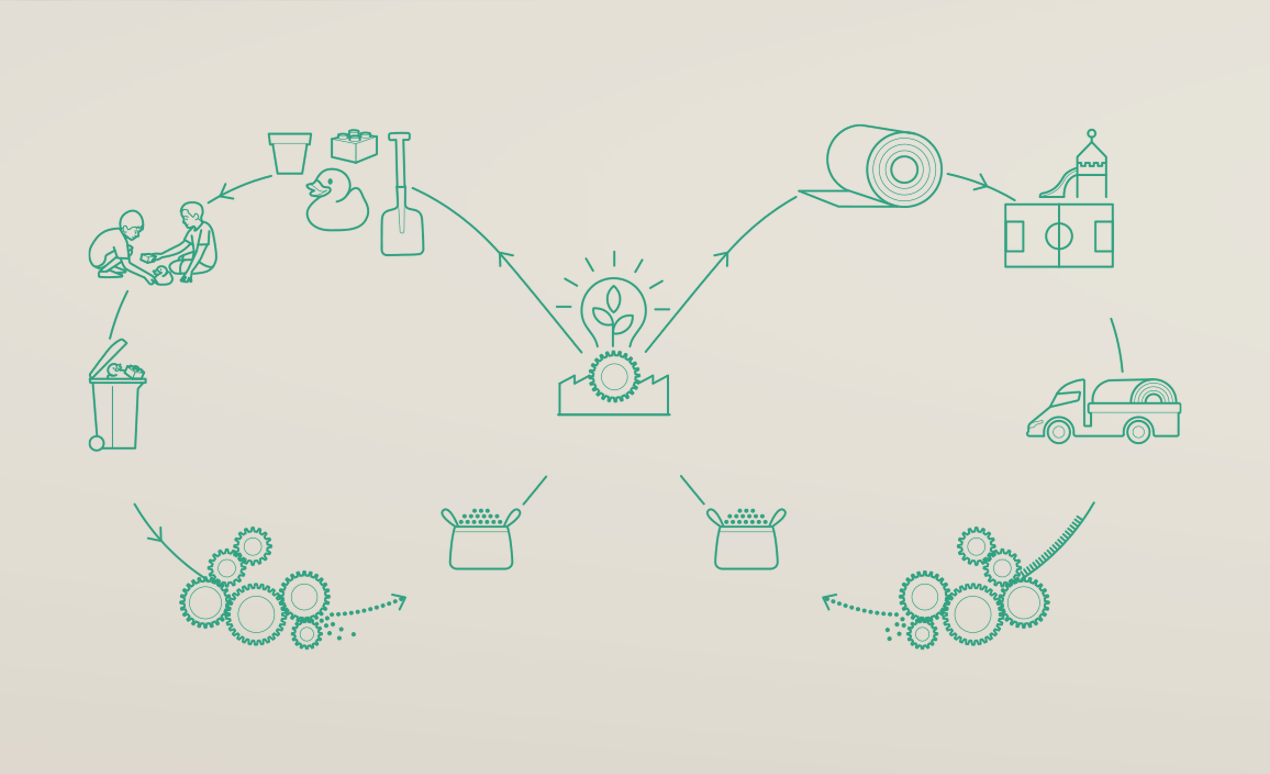
Recycling is the process of converting used materials into new raw materials or products. The objective is to reduce waste, preserve resources and keep valuable materials in circulation for as long as possible.
The effectiveness of recycling often depends on how a product was designed in the first place.
Why Artificial Grass Can Be Challenging to Recycle
Many traditional artificial grass systems contain multiple material types, including different polymers used for fibres, backing layers and coatings.
While these systems can perform effectively during use, their mixed-material composition can create challenges at the end of life.
Typical challenges include:
- Material separation requirements
- Increased processing complexity
- Higher recycling costs
- Reduced material purity after processing
When multiple materials are processed together, the resulting recyclate may have fewer potential applications than the original raw materials.
The Importance of Design for Recycling
Across many industries, Design for Recycling is becoming an increasingly important principle.
The concept is straightforward: products should be designed in a way that supports efficient processing and material recovery once they are no longer needed.
One approach is mono-material design.
Mono-Material Artificial Grass
Mono-material products are based on a single material family rather than a combination of different polymers.
This approach can provide several advantages:
- Greater material transparency
- Reduced complexity during processing
- Improved material consistency
- Potential for higher-value recycling pathways
The objective is not simply to recycle more material, but to preserve material quality wherever possible.
The ONE-DNA™ Approach
ONE-DNA™ artificial grass applies a mono-material polyethylene design.
By using a single polymer family throughout the product structure, the concept aims to simplify future processing and support Design for Recycling principles.
This approach reflects a broader trend across multiple industries where manufacturers are exploring simpler material structures to improve recyclability and material recovery.
The Role of Environmental Data
Understanding environmental performance requires more than assumptions.
ONE-DNA™ products are supported by Environmental Product Declarations (EPDs), which provide independently verified environmental information based on Life Cycle Assessment methodology.
These documents help stakeholders evaluate products using transparent and comparable environmental data.
Looking Ahead
The future of artificial grass recycling is likely to be influenced not only by recycling technology, but also by product design.
As regulators, municipalities, designers and project owners increasingly focus on material transparency and circularity, the composition of products will become a more important part of procurement and specification decisions.
The central question is no longer simply whether a product can be recycled, but how effectively it was designed for its next lifecycle.
Update, October 2026: this article reflects the ONE-DNA™ range at the time of publication, based on polyethylene (PE). ONE-DNA™ now also includes a 100% PO route; see Technology. The EPDs mentioned (MRPI, 2024) cover the product stage (A1 to A3) of products made at the former Hasselt site and do not represent current production in Portugal.
Related: Sustainability · Technology