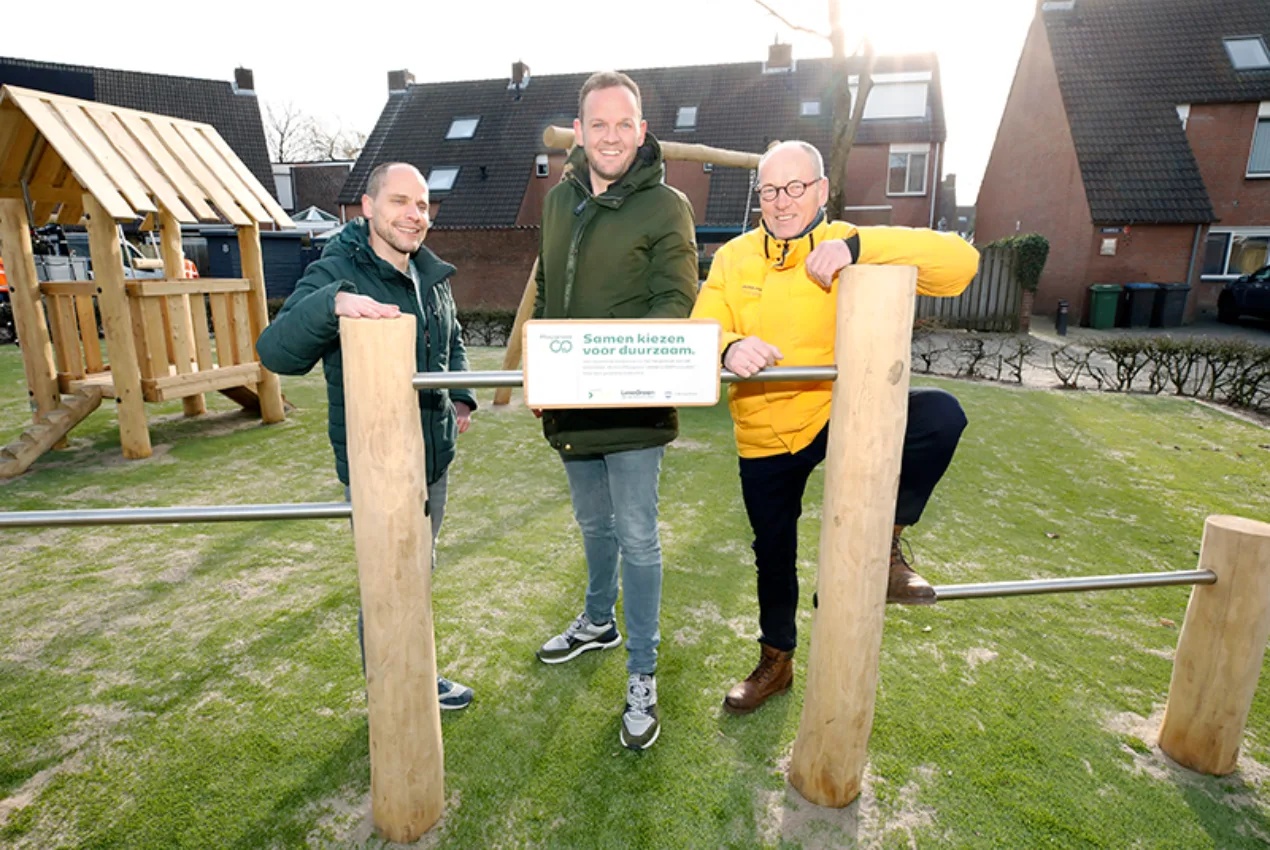
The renovation of a playground in ’s-Hertogenbosch demonstrates how municipalities and contractors are increasingly incorporating sustainability and circularity considerations into public space projects.
Commissioned by the municipality of ’s-Hertogenbosch and delivered by KSP Kunstgras, the project involved the transformation of an existing playground, including new play equipment and an impact-absorbing artificial turf surface. Throughout the design and construction process, the focus was placed on creating a durable solution while maximising the use of recycled and recyclable materials.
Starting with the needs of the community
The project began with an important question: what kind of play environment would best serve local children and residents?
According to Marcel van Mierlo, Neighbourhood Manager for the municipality of ’s-Hertogenbosch, the wishes and requirements of local users were first mapped out to ensure that the renovated playground would provide long-term value for the community.
Alongside functionality and safety, sustainability was identified as a key project objective.
A system-based approach
To support these ambitions, the project combined several materials and components designed to contribute to resource efficiency throughout the system.
The renovation included:
- Recycled edging boards
- Shock pads
- Recycled infill sand
- ONE-DNA™ artificial turf
By considering the complete system rather than individual components, the project team was able to use recycled and recyclable materials throughout the playground surface construction.
Learning through practice
Artificial turf continues to play an important role in locations where intensive use makes natural grass difficult to maintain. As sustainability requirements evolve, municipalities and contractors are increasingly exploring solutions that support durability, resource efficiency, and responsible end-of-life management.
The playground in ’s-Hertogenbosch provides an opportunity to gain practical experience with these materials in a real-life environment.
Monitoring performance over time
To better understand the long-term performance of the system, the ONE-DNA™ team, KSP Kunstgras and the municipality will periodically inspect the impact-absorbing surface in the coming years.
These evaluations will help provide insights into durability, maintenance requirements, and future opportunities for product and system development.
Jasper Eppingbroek comments:
Projects such as this allow us to learn from practical applications and further improve our products and systems. By working together with municipalities and contractors, we can continue to develop solutions that balance performance, safety, and sustainability over the long term.
We would like to thank the municipality of ’s-Hertogenbosch and KSP Kunstgras for their collaboration on this project and look forward to following its performance in the years ahead.
Related: Playgrounds · Sustainability