

Most artificial grass is judged by what’s on top. ONE-DNA™ starts underneath: fibre and backing joined by heat, and each product built from one material route.
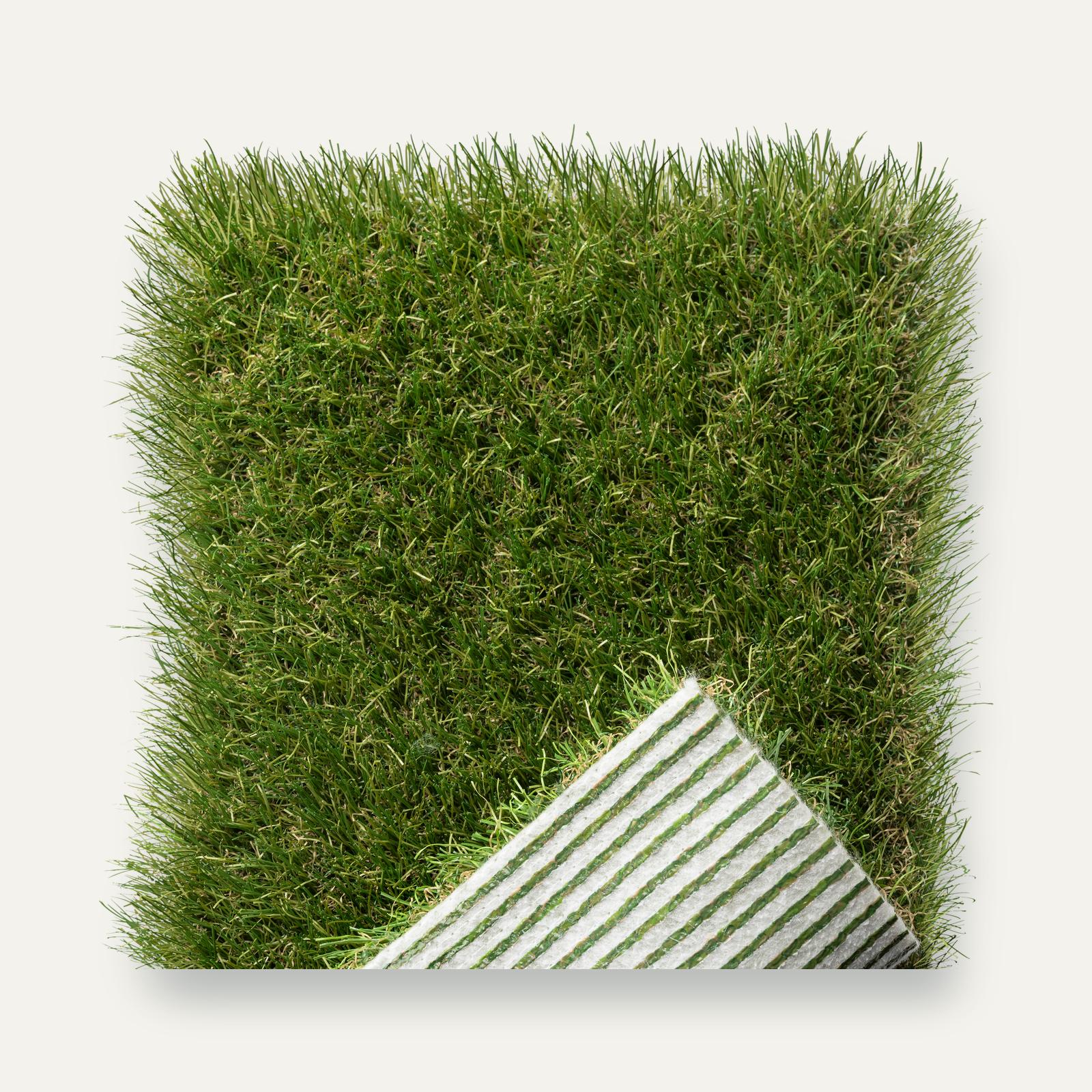
A ONE-DNA™ sample, turned over. The white backing is the construction, not a coating.
The film
See the whole idea in under two minutes.
From the first material choice to what can happen at the end of a surface’s life. Best watched with sound on.
FuseTech™
Fibre and backing, joined by heat.
FuseTech™ is how ONE-DNA™ is made. Instead of gluing the fibres in with a secondary coating, it bonds them into the backing with heat.


On the production line: fibre and backing, joined without a secondary coating.
01
Heat, not coating.
Fibres are thermally bonded into the backing, without a conventional latex or polyurethane secondary coating.
02
One layer fewer.
Without the coating, that material layer is simply not part of the construction.
03
An earlier question.
A conventional coating has to be separated from fibre and backing again before they can be recovered. ONE-DNA™ asks why that complexity is built in at all.
Material routes
One principle. Three material routes.
The application decides the route. Each one keeps the construction to the materials the job actually needs.
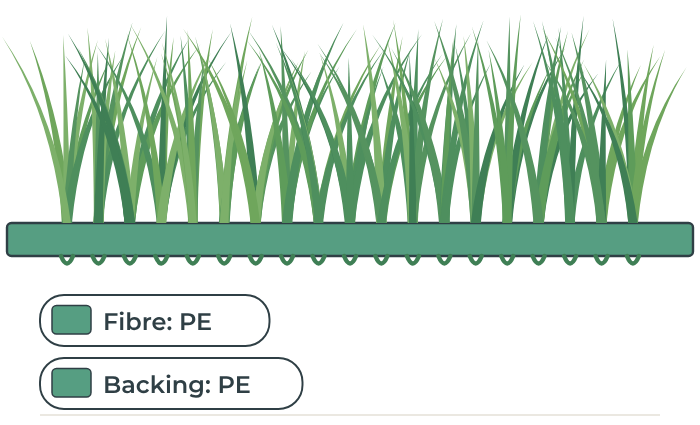
100% PE
Polyethylene
Polyethylene in both fibres and backing: one polymer throughout. Soft and flexible, for lawns and landscapes where comfort and feel come first. Where heat or stability matter most, another route may suit better.
Suited to
Gardens · Landscaping · Roof systems
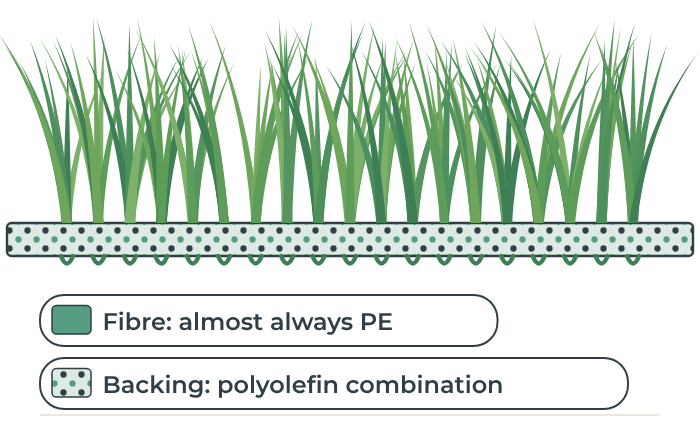
100% PO
Polyolefin
Combining the softness of PE fibres with the stability of a PP backing: two polymers from the same polyolefin family. Generally the most versatile route, and the route for every ONE-DNA™ sport surface.
Suited to
All seven applications
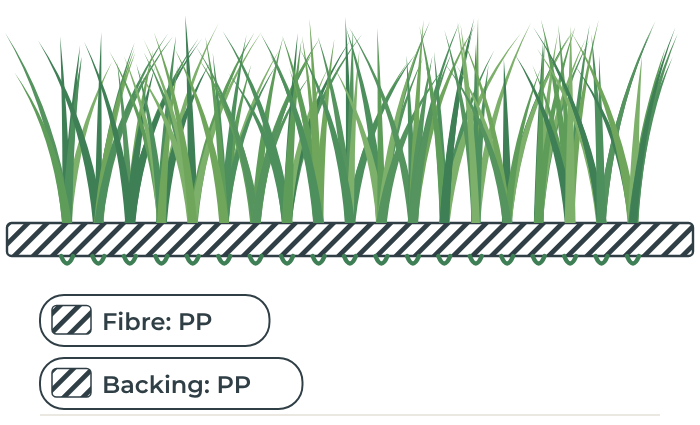
100% PP
Polypropylene
Polypropylene in both fibres and backing: one polymer throughout. Firmer underfoot than PE, for functional surfaces such as retail displays, events and some indoor spaces. Depending on the construction, it can be a more economical route.
Suited to
Events · Indoor · Retail
Performance in practice
Made to let water through.
Good drainage starts with a water-permeable turf. Watch water pass through ONE-DNA™ artificial grass in this short demonstration.
Water permeability, tested to EN 12616
A documented test of ONE-DNA™ turf to EN 12616 recorded a water permeability of at least 650 l/min/m². Current ONE-DNA™ product lines share the same water-permeable construction.
The measured value applies to the tested turf. How quickly a finished installation drains also depends on the base, the drainage design and local conditions.
Evidence
Every result tied to its product.
A construction is only as convincing as its evidence. These are the questions we test, and each answer belongs to the product and build-up named in the report.
What is it made of?
SGS identifies the fibre and backing materials of the tested product (FTIR).
What is in the material?
SGS tests for substances of very high concern, PAHs and the migration of elements to EN 71-3.
Does anything leach out?
SGS tests the leaching of heavy metals and salts, on the constructions the report names.
How does it age?
SGS assesses material properties after 2,500 and 5,000 hours of controlled UV, heat and water.
How does it perform in use?
Drainage, impact attenuation and reaction to fire are tested for the relevant product and system configuration.
What is its footprint?
Life cycle assessment is part of how products are developed: it shows where impact sits and what to improve. Results are shared with their scope.
Find the construction your project needs.
Start with the application. The product and its route follow from what the surface has to do.
FAQ
Questions about the technology
FuseTech™ is the ONE-DNA™ production technique that bonds the fibres into the backing with heat. It replaces the conventional latex or polyurethane secondary coating, so that layer is not part of the construction.
No. Fibre and backing are joined with heat instead of a conventional latex or polyurethane secondary coating. The full material composition is documented per product.
No. The 100% PE and 100% PP routes use one polymer in fibre and backing. The 100% PO route is a polyolefin construction that combines PE and PP. The route of each product is stated in its documentation.
It is designed for recycling: a simpler construction leaves less to separate. Whether a surface is actually recycled depends on removal, collection, sorting and the processing available where it ends up. More on end of life →
No. Each result applies only to the product and build-up named in the report. For example, the EN 1177 reports for ONE-DNA™ Play 24 and Vista cover the PE versions and build-ups tested. Ask for the report for the product you plan to use.
Start with the application. 100% PE is soft and flexible, 100% PP is firmer and suits functional surfaces, and 100% PO, with soft PE fibres on a stable PP backing, is generally the most versatile. Each product is listed with its route. Explore products →
Something not covered here? Ask us about a specification →